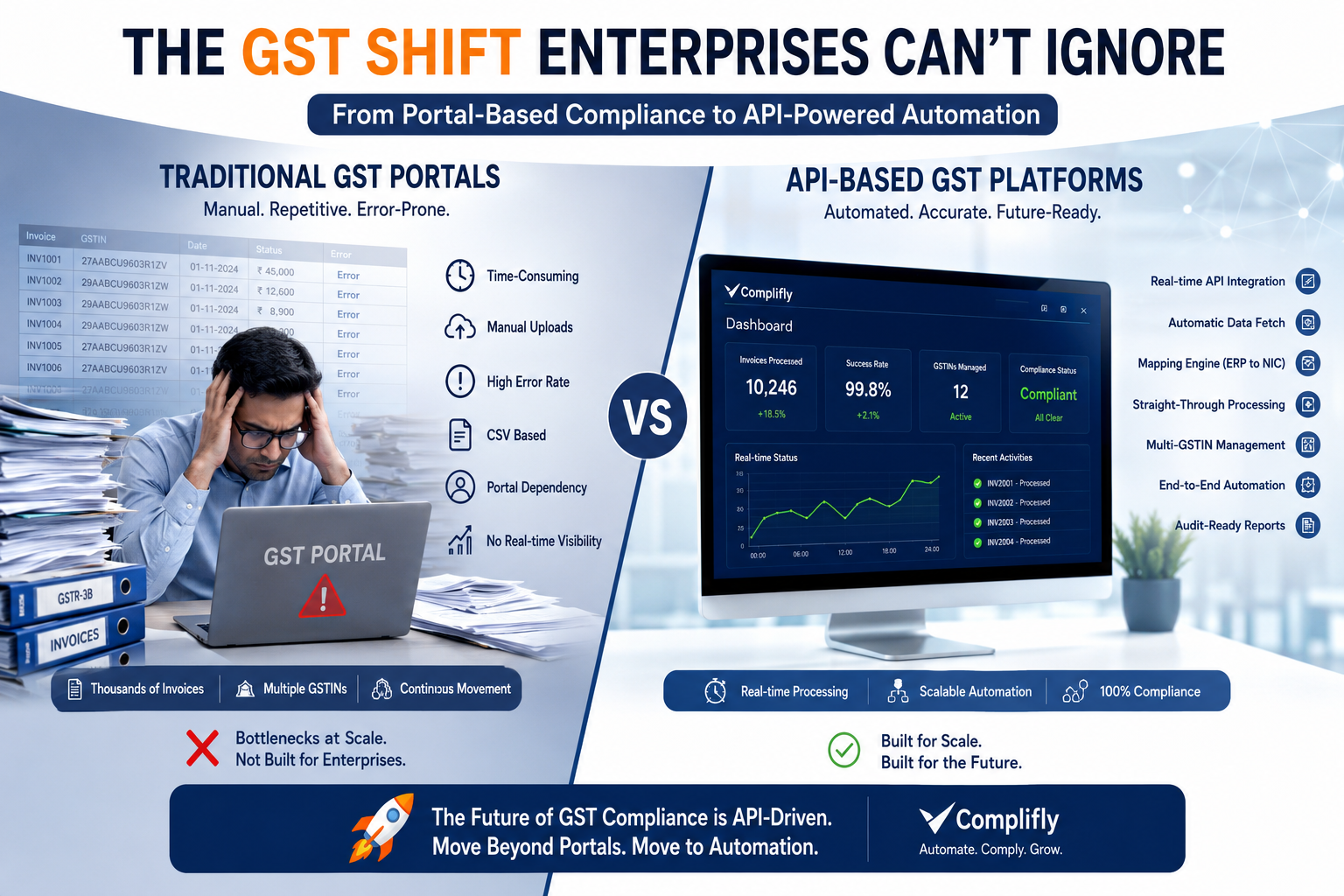
For years, GST compliance meant logging into portals, uploading invoices, fixing errors, and repeating the process every day.
It worked when transaction volumes were low.
But today, enterprises handle thousands of invoices, multiple GSTINs, and continuous business operations. At this scale, manual uploads and portal-based workflows become slow, inefficient, and difficult to manage.
The Challenge
Most GST issues today are not caused by tax regulations.
They are caused by outdated compliance processes.
Common problems include:
Manual invoice uploads
Frequent validation errors
Delayed IRN and e-Way Bill generation
Lack of real-time visibility
Managing multiple GSTINs across locations
Dependence on compliance teams for routine tasks
As businesses grow, these challenges grow with them.
Why Enterprises Are Choosing API-Based Compliance
Instead of uploading data to portals, modern businesses connect their ERP systems directly with GST platforms through APIs.
This allows:
✅ Automatic IRN generation
✅ Real-time e-Way Bill creation
✅ Faster processing
✅ Fewer manual errors
✅ Better visibility and control
✅ Seamless ERP integration
Compliance becomes part of the business workflow rather than a separate activity.
The Power of Automation
With API-based platforms, invoice data flows directly from the ERP system to GST systems.
No manual uploads.
No repeated data entry.
No waiting for files to be processed.
Everything happens automatically and in real time.
The Future Is Straight-Through Processing (STP)
Leading enterprises are adopting Straight-Through Processing (STP), where invoices move from ERP to GST systems without human intervention.
The result:
The Bottom Line
Traditional GST portals were built for manual compliance.
Modern enterprises need automated compliance.
As transaction volumes continue to grow, businesses are moving toward API-driven platforms that offer speed, accuracy, and scalability.
The future of GST compliance is not more uploads.
It's automation.